
This quarter, Hillman Scholars published new work spanning global health, maternal and adolescent health, health…
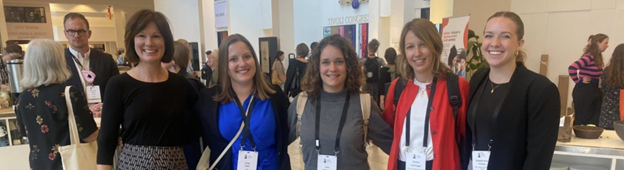
Photo (L–R): Joyce Edmonds (UMB Nursing; JOGNN; Ariadne Labs), Larissa Zeller (midwifery master’s student), Talea (midwifery student), Vanessa Leutenegger (midwife & lecturer, ZHAW Zurich University of Applied Sciences), with UNC-Chapel Hill Hillman Scholar (’26), Liz Finnessy.
by Elizabeth (Liz) Finnessey | December 2025 In a vast auditorium in Copenhagen, an American Nursing PhD student, standing shoulder-to-shoulder with midwives, nurses, researchers, policymakers, and others who serve in birth spaces. On stage, a small group of young women form a wide arc around a cluster of microphones. It’s the final portion of the opening ceremony of the Nordic Midwifery Congress.
Then, we all begin to sing.
Softly at first, then stronger, our voices rise together:
“Imagine all the people, living life in peace…”
A lump forms in my throat. I think of home, of the United States, and all the people whose rights, dignities, and bodies are under siege.
You.
My future as a women’s health researcher feels more fragile than ever before.
Then the chorus begins.
“You may say that I’m a dreamer…”
I nearly sob. A surge of emotion crashes over me. Grief, yes, but also defiant hope.
“…but I’m not the only one.”
I look around. I am not alone.
Here in this room, surrounded by birth workers from across the globe, I feel the collective ache, the shared outrage, and the common dream: of justice. Of peace. A dream of perinatal health care that honors the full humanity of every birthing person.
“I hope someday you’ll join us…”
It’s not just a lyric. It’s a call to rise. To resist. To keep imagining, innovating, and advocating so that “the world will be as one.”
A new fire was lit inside me, reinvigorating me with renewed passion and drive to continue the work that I’m doing in women’s health and implementation science; to improve health care delivery at a systems level. As a result of attending the Nordic Midwifery Congress, I felt reconnected with my ‘why’ and was reminded of the joys and challenges of being a birth worker. This renewed motivation came from speaking with many, many folks who were horrified about what was happening in the United States. It felt so good to know that American researchers were not alone, and our colleagues overseas are cheering for us. This hopeful comradery pulled me from the dark pit of despair where I had been spending so much of my time. So much so, that I was able to take my small seed of hope, and water it.
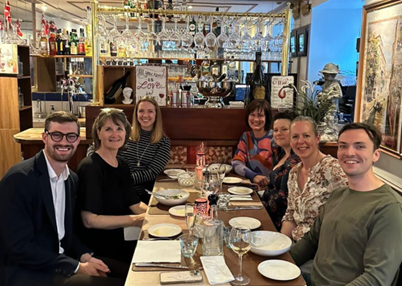
Watering my little seed of hope looked like intentional networking to prepare for what comes after my dissertation. My dissertation focuses on determinants to clinic-level implementation processes for the evidence-based guidelines for the timely recognition and response of hypertensive disorders of pregnancy in the outpatient setting.
Thanks to Dr. Amber Weiseth, I was connected to an extensive network of international colleagues specializing in maternal health innovation across Europe. Now, my seed of hope has sprouted. I can see avenues for change stretch out ahead of me like golden vines into the future. I’m more motivated than ever to complete my dissertation so that I can truly grasp onto one of these vines and pull myself into the next chapter of changemaking.